
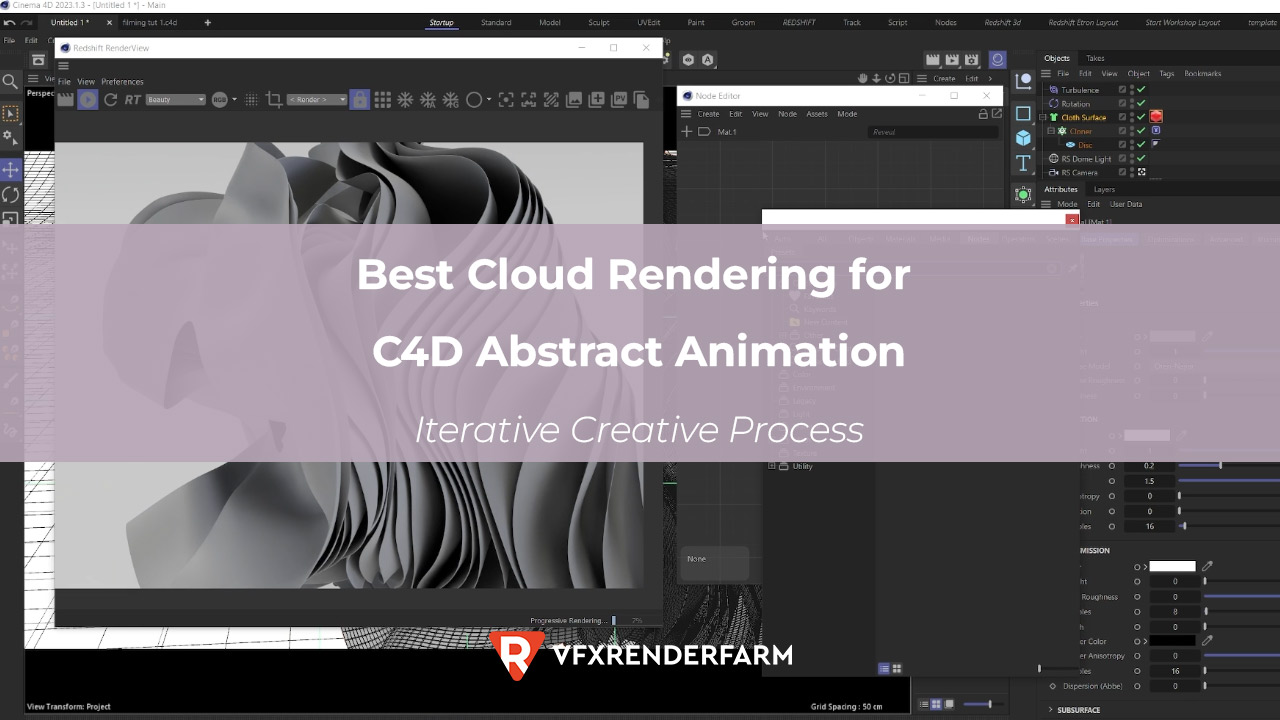
Abstract animation is fundamentally iterative and that changes which cloud farm works best. A typical abstract MoGraph session for me involves 8-12 test renders before I commit to the full 300-frame sequence.
Last Updated: May 2026
Abstract animation is fundamentally iterative and that changes which cloud farm works best. A typical abstract MoGraph session for me involves 8-12 test renders before I commit to the full 300-frame sequence. Tweak a shader, render 5 frames. Adjust particle speed, render 5 more. On iRender, those 8-12 test renders happen inside one continuous session. I’m already in the Redshift viewport, so each iteration takes 30 seconds to start. Total cost for a 2-hour creative session: ~$16.40. On GarageFarm, each iteration would be a separate submission – upload, wait, download, review, re-upload. At roughly $1.50 per submission and 8-12 minutes turnaround each, that’s $12–18 just for test renders, plus the final render on top. For creative work, the IaaS viewport is worth every penny of the hourly rate.
| Workflow Step | iRender (IaaS) | GarageFarm (SaaS) |
|---|---|---|
| Test render #1 (5 frames) | 30 sec start, included in session | $1.50, ~10 min turnaround |
| Test renders #2-#8 (avg) | 30 sec each, included | $1.50 each, ~8 min each |
| Total test render cost | $0 extra (session time) | $12-18 (8-12 submissions) |
| Total test render time | ~15 min (inside session) | ~80-120 min (round-trips) |
| Final 300-frame render | 28 min, included in session | $8.40, ~30 min |
| Creative session total | ~$16.40 (2 hr session) | ~$22-28 (tests + final) |
Why Does Iterative Abstract Work Cost More on SaaS Farms?
Because every tweak is a new submission. On GarageFarm, each test render means: re-export scene → upload → queue → render → download → review. Even fast 5-frame tests take 8-12 minutes round-trip. When you’re chasing a feeling, trying to get that exact particle flow or that perfect Fresnel gradient. You might do 10 iterations in an hour. On SaaS, that’s 10 separate jobs. On iRender, it’s 10 clicks of the render button.
I learned this the hard way. Early on, I submitted an abstract piece to GarageFarm iteratively – 14 submissions over two days. Total cost: $26 in test renders plus $9 for the final. If I’d opened one iRender session and done the same exploration, it would’ve been about $20 total. The math only works for SaaS when you already know exactly what you want and just need raw render power.
How Do I Use Redshift’s IPR Preview on a Cloud Server for Abstract Work?
This is where iRender’s IaaS model shines for creative work. Redshift’s Interactive Preview Render (IPR) runs in real-time on the RTX 4090. I see lighting, material, and motion changes updating live in the viewport. On my local RTX 3070, IPR stutters on complex particle scenes. On iRender’s 4090 with 24 GB VRAM, the same scene runs smooth at near-final quality.
My abstract workflow: open Cinema 4D on the cloud server, enable Redshift IPR, and spend 30-45 minutes exploring looks. Once I land on something, I render the full sequence without closing the session. No uploading. No downloading between iterations. No waiting. The only downside: the billing timer runs the entire time I’m exploring. A 2-hour creative session costs $16.40 even if I only render 28 minutes of actual frames. That’s the premium for having a real-time creative tool in the cloud. For me, it’s worth it. For someone who designs locally and just needs cloud for final output, GarageFarm makes more sense.
This is where I explore abstract looks in real-time → Try iRender for creative MoGraph
FAQ
Is a cloud render farm worth it for abstract animation that needs constant tweaking?
On IaaS farms like iRender – absolutely. You get a real-time Redshift viewport on an RTX 4090, so tweaking materials and motion is instant. A 2-hour creative session costs about $16.40 and includes unlimited test renders within that time. On SaaS farms like GarageFarm, each tweak is a separate submission ($1.50 each, 8-12 min turnaround), which kills the creative flow and costs more for iterative work. Use IaaS for exploration, SaaS for final batch output when you’ve locked the look.
How many iterations does abstract MoGraph typically need before final render?
In my experience, 8-12 test renders per piece is average for abstract work. Some sessions I nail it in 4 iterations. Complex particle pieces with procedural shaders can take 15-20. Each iteration is usually a 3-5 frame test, enough to check motion, color, and timing. On iRender, those tests cost nothing extra beyond the hourly session rate. I budget 1.5-2 hours of server time per abstract piece, which covers exploration plus the final render.
Can I use Redshift IPR preview on a cloud server like iRender?
Yes, and it’s faster than most local workstations. iRender’s RTX 4090 with 24 GB VRAM handles Redshift IPR at near-final quality, smooth real-time preview even with heavy particle counts and volumetrics. You access it through remote desktop, open Cinema 4D, and enable IPR just like you would locally. The viewport responds to material and lighting changes in real-time. Latency depends on your internet connection, but on a stable 50+ Mbps connection, the delay is barely noticeable for creative work.
You may want to read other articles of mine here.
Image source: Derek Kirk (Effectatron)

COMMENTS