
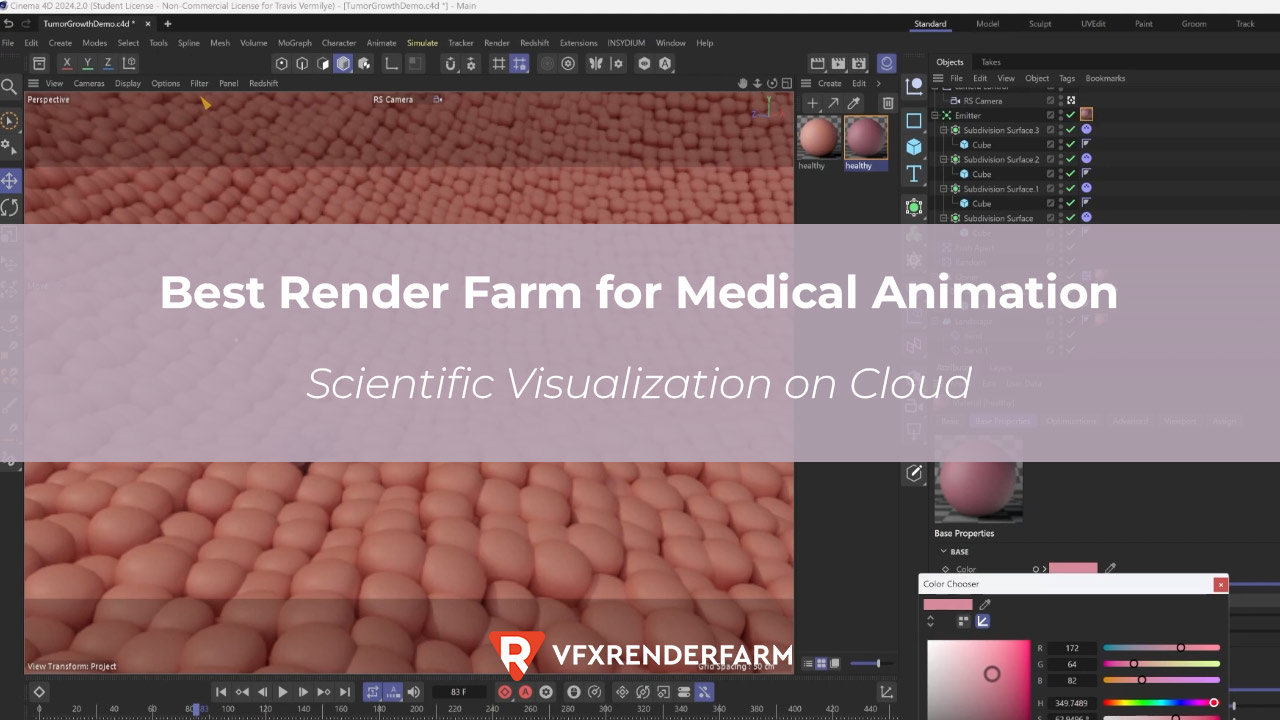
The best render farm for medical animation is iRender for C4D and Maya scientific visualization workflows, and GarageFarm for straightforward 3ds Max molecular scenes.
Last Updated: April 2026
The best render farm for medical animation is iRender for C4D and Maya scientific visualization workflows, and GarageFarm for straightforward 3ds Max molecular scenes. Medical animation is a growing niche that demands unusually high render quality: transparent cell membranes, volumetric protein structures, subsurface scattering on organic tissue, and precise depth of field for microscopic environments. These effects require 1024-2048 samples without denoising because noise in medical imagery looks like measurement artifacts, which pharmaceutical clients reject. I rendered a 90-second pharma mechanism-of-action (MOA) animation for a biotech client: 2,160 frames, C4D Redshift, 1080p, 1024 samples. Total cost: $26.40 on iRender (4× RTX 4090, 1h 40min). The same job on GarageFarm was quoted at $48. For medical animators, cloud rendering solves the most common bottleneck: revision-heavy pharma approval cycles that require 4-8 re-renders per project.
| Medical Animation Type | Duration | Key Render Challenge | iRender Cost |
|---|---|---|---|
| Mechanism of action (MOA) | 60-90s | SSS tissue + transparent membranes | $18-28 |
| Molecular visualization | 30-60s | Volumetric proteins + DOF | $12-22 |
| Surgical procedure | 2-3 min | SSS skin + metallic instruments | $35-55 |
| Cell biology (micro scale) | 60-90s | Transparent layers + particle transport | $22-38 |
| Pharma product + MOA combo | 2-3 min | Clean product shots + MOA sequence | $40-65 |
Why Does Medical Animation Cost More Per Frame Than Standard MoGraph?
Medical animations use 3 effects that dramatically increase render time. First: subsurface scattering (SSS) on organic tissue – cell walls, blood vessels, and skin require SSS for biological accuracy. SSS needs 3-5× more samples than diffuse materials to resolve cleanly. Second: transparent/translucent layers – cell membranes, protein sheaths, and fluid environments stack multiple transparency layers, each adding ray depth complexity. I typically set ray depth to 12-16 for medical scenes vs 4-6 for standard MoGraph.
Third: depth of field at microscopic scale. Medical animations simulate microscope optics with extremely shallow DOF, which requires high sample counts to render the bokeh smoothly. These three factors combined make a typical medical frame render 2-4× longer than an equivalent-complexity MoGraph frame. A 90-second MOA at 1024 samples costs $26 vs $12-15 for a standard 90-second MoGraph piece.
How Does the Pharma Revision Cycle Affect Render Farm Choice?
This is where medical animation uniquely benefits from cloud rendering. Pharmaceutical clients operate under regulatory review – medical-legal-regulatory (MLR) teams review every animation frame for scientific accuracy. A typical pharma project requires 4-8 revision rounds, each involving re-rendering the entire sequence after adjustments to color, text labels, molecular positioning, or disclaimer overlays.
On iRender, each revision re-render costs $18-28 for a 90-second MOA. Over 6 revision rounds: approximately $130-170 total rendering cost. On GarageFarm, the same 6 rounds cost approximately $240-290. The $100+ savings per project is significant because medical animation projects typically charge $5,000-15,000 per minute; rendering is a small fraction, but unnecessary cost on GarageFarm adds up across multiple pharma projects annually.
My honest recommendation: if you’re a solo medical animator doing 1-2 pharma projects per year, use GarageFarm for simplicity. The $100 premium isn’t worth the setup overhead. If you’re a medical animation studio handling 5+ pharma projects annually, the iRender savings compound to $500-1,000/year, worth the learning curve.
For medical animation rendering with high sample counts → View GPU servers on iRender
FAQ
How much does it cost to render a medical animation on a cloud render farm?
A 90-second mechanism-of-action (MOA) animation costs $18-28 on iRender or $38-48 on GarageFarm. A 2-3 minute surgical animation costs $35-65 on iRender. Medical animations cost 2-4× more per frame than standard MoGraph due to SSS tissue, transparent layers, and high sample counts (1024-2048 without denoising). Budget for 4-8 revision re-renders per pharma project.
Why do medical animations need higher render samples than other 3D work?
Medical visualizations rely heavily on subsurface scattering (organic tissue), stacked transparent layers (cell membranes), and shallow depth of field (microscope optics). These effects need 1024-2048 samples to render noise-free. Noise in medical imagery resembles measurement artifacts – pharmaceutical clients and MLR review teams will reject noisy frames as scientifically inaccurate.
Which render farm is better for pharma animation with many revision rounds?
iRender for studios doing 5+ pharma projects yearly, saving $100+ per project across 4-8 revision re-renders. GarageFarm for solo animators doing 1-2 projects annually, simplicity outweighs the cost difference. A typical 6-round revision cycle costs $130-170 on iRender vs $240-290 on GarageFarm for 90-second MOA animations.
You may want to read other articles of mine here.
Image source: Travis Vermilye

COMMENTS