
An IaaS render farm offers full control over your rendering environment, making it a smart option when flexibility and quick adjustments matter. This article explains why IaaS is worth considering if you plan to outsource rendering for complex or changing projects.
Rendering has always been one of the most demanding parts of any 3D or VFX workflow. Over time, as scenes get heavier and deadlines get tighter, I’ve seen more artists start to look beyond local machines and explore different render farm solutions. This article aims to highlight the key benefit of using an IaaS render farm and explain why it’s worth considering if you’re planning to outsource your rendering. Rather than making absolute claims, it focuses on why I personally see IaaS as a smart and practical option for many rendering scenarios, based on how it works and how artists typically use it in real-world production.
What’s a IaaS render farm?
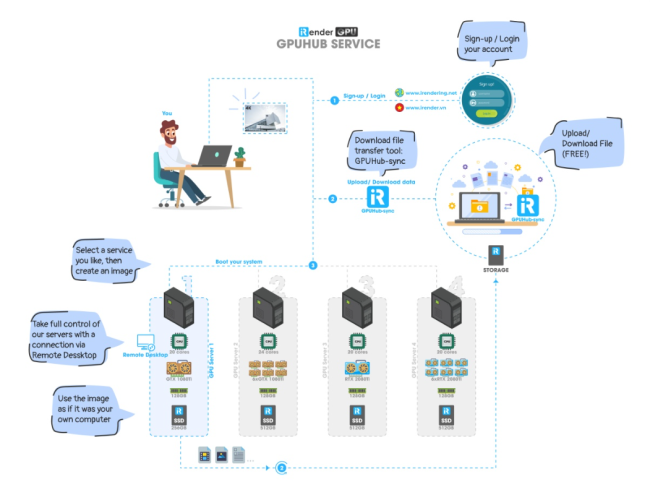
An IaaS render farm is a rendering solution that uses cloud-based infrastructure such as CPUs, GPUs, storage, and networking,… provided through an Infrastructure as a Service (IaaS) model. Instead of rendering on local machines, artists and studios use rented cloud infrastructure to handle their rendering workloads. Unlike traditional render farms, an IaaS render farm gives users direct access to and control over the remote machine and users need to set up a working environment and render by themselves.
Why is an IaaS render farm the better choice for rendering?
Now that the definition of an IaaS render farm is clear, the next question is why it’s worth considering at all. From my perspective, one thing that makes an IaaS render farm better than other types of render farm is the level of control an IaaS render farm gives you over your rendering environment – full control. You’ll see that what I’m saying is true when you need to render complex projects that require constant monitoring.
The key difference of IaaS render farms is not simply that users can choose software or render settings because that’s something many SaaS-based render farms also require, but that users are fully responsible for setting up and maintaining their own working environment. With an IaaS, the entire rendering environment is built and managed by users, rather than being partially abstracted or controlled by the service provider.
What makes this particularly valuable is how quickly users can react when something changes. If there’s a last-minute update, a plugin issue, a version mismatch, or an unexpected technical adjustment, users can modify the environment immediately without waiting for the render farm’s support team or predefined system updates. In real production scenarios, this level of responsiveness can save a significant amount of time and restrict unexpected issues during tight deadlines.
This ability to directly manage and adjust the rendering environment on demand is, in my view, the core reason why IaaS render farm offers a fundamentally different experience. Instead of working within a controlled service layer, you’re effectively running your own render setup, which helps you timely solve any issues as fast as it occurs.
Of course, this level of control isn’t always necessary. If your scene is already stable, all settings are locked in, and you don’t need to actively monitor or adjust the rendering environment during the process, then this core characteristic of IaaS may not add much value. In situations where deadlines are tight and you simply want to hand off the files and get the final output as quickly as possible, a SaaS-based render farm can be a more practical choice.
If you look for an IaaS render farm, iRender is the smart choice. Besides, if you need other types of render farms such as SaaS, you may consider RebusFarm, Fox Renderfarm, GarageFarm,…
Final Thoughts
In short, IaaS isn’t about having more features, it’s about having more control. If you like knowing exactly what’s happening under the hood and being able to tweak things on the fly, IaaS can feel pretty empowering. And if that level of control doesn’t matter for your project? No worries. There are other render farm options that get the job done just fine. It’s really about picking what fits your workflow best and keeps your stress level low during renders.

COMMENTS