
A practical breakdown of the top 5 best render farms for 2026, comparing pricing models, workflows, and how AI is reshaping the role of cloud rendering in modern 3D production.
If you’ve been following this blog for a while, you’ll know that at the end of each year, I often write a post reflecting on how the render farm landscape has evolved over the past year. And this year is no different. As 2025 comes to an end, it’s a good time to look back at how much the 3D rendering landscape has changed, with projects becoming more complex and expectations around speed and quality continuing to rise. As a result, render farms have become an increasingly important part of many workflows. In this article, I’ll reflect on recent market shifts and share my thoughts on the top 5 render farms to keep in mind for 2026.
What’s Happening In The 3D Rendering Market?
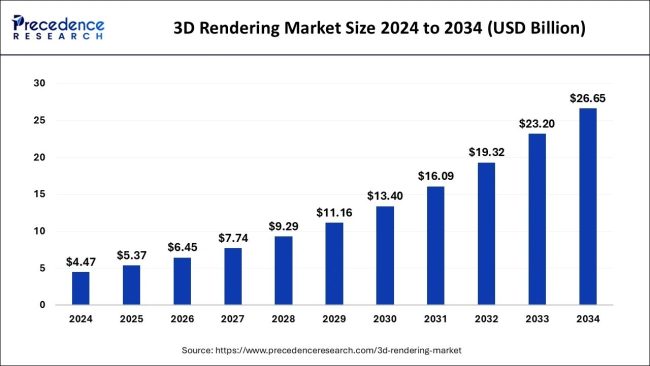
First, let’s look at the 3D rendering market share. Because there are currently no accurate statistics on the 3D rendering market share for 2025, we will look at the projected figure from 2024.
As expected, in 2025, the global 3D rendering market has been estimated to be valued at a solid $5.37 billion, and it’s expected to skyrocket to $26.65 billion by 2034. Looking at this, we can see that the growth rate has been accelerating over the years.
So what’s driving this continued growth going into 2025? Here’s how things look:
1. Ongoing Technological Improvements
Rendering technology didn’t slow down in 2025 even though the economy still has been unstable. GPUs continue to get more powerful, real-time rendering tools are becoming more practical and modern software is handling heavier scenes more efficiently than before. These steady improvements have made high-quality rendering faster and more accessible across different types of projects.
2. Broader Industry Demand
3D rendering is no longer limited to a few specialized fields. In 2025, its use has expanded even further across entertainment, architecture, automotive design, advertising, virtual production, etc. As more industries rely on 3D visuals, the demand for scalable rendering solutions has continued to grow.
3. Rising Expectations for Visual Quality
Audience expectations keep increasing. Whether it’s more detailed environments, cinematic lighting, or realistic materials, visual quality now plays a bigger role than ever. This push for higher standards is one of the key reasons why rendering workflows and the tools that support them are evolving so quickly.
Where Is 3D Rendering Used?
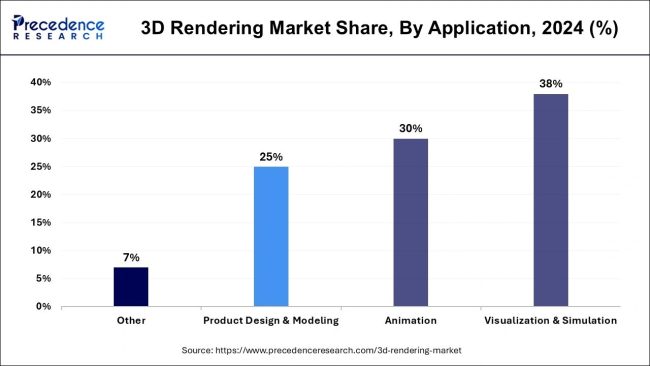
3D rendering is used across a wide range of industries:
- Visualization & Simulation taking the largest share at 38%. This includes applications such as architectural visualization, industrial simulations, training environments, and technical demonstrations, where realistic visuals play a critical role
- Animation follows at 30%, driven by demand from film, gaming, and digital media production
- Product Design & Modeling accounts for 25%, reflecting the importance of 3D rendering in product development, prototyping, and industrial design
- Meanwhile, other use cases make up a smaller portion of the market at 7%, showing that most demand comes from established, professional workflows rather than niche applications
Will AI Replace 3D Artists/Traditional Rendering?
As you can see, over the past year, AI-generated visuals have started to influence certain areas of the 3D industry, especially for small-scale advertising projects or clients with very tight budgets and deadlines. In my opinion, AI tools can sometimes replace traditional rendering workflows, delivering “good enough” visuals at a fraction of the time and cost. For simple concepts, mood visuals, or fast-turnaround content, AI can realistically cover 70-80% of the final output without requiring full 3D rendering.
However, this shift does not mean render farms are becoming less relevant. I usually work with clients who have strict requirements for their high-quality projects, brand-sensitive advertising, product visualization, animation, and complex scenes and I think traditional rendering remains essential. These projects still demand physical accuracy, consistent lighting, detailed materials, and full creative control – areas where AI tools currently fall short. In such workflows, render farms continue to play a central role, providing the computing power needed to meet professional standards at scale.
In short, AI may reduce the need for rendering in certain low-complexity use cases, but for serious production work, for me, rendering and by extension, render farms remains a core part of the pipeline.
Why Render Farms Matter More Than Ever?
As I mentioned above, 3D artists are unlikely to be completely replaced by AI and render farms will therefore continue to play an important role in saving resources:
- Modern Tech: Render farms make it easier to use powerful GPUs and up-to-date software without the need to constantly upgrade in-house systems
- Scalability: Whether it’s a small scene or a large batch of renders, render farms allow users to scale resources up or down depending on the project’s needs
- Faster turnaround: By distributing workloads across multiple machines, render farms help reduce render times and keep production moving
- Cost-effective: Instead of maintaining dedicated infrastructure, many users turn to render farms as a more flexible and predictable option for handling heavy rendering tasks with reasonable price
My Top Best Render Farms For 2026
Below is the top 5 best render farms I highly recommend you use in 2026:
iRender Farm
Why it stands out: Established in 2019 in Vietnam, iRender Farm is one of the top best render farms in my mind. It provides both single-GPU and multi-GPU with full control over remote servers. Built around an IaaS model, iRender allows users to run all software and engines by themselves without being locked into a specific workflow.
| Service model | IaaS-based render farm |
| How it works | Setup working environment and render by users themselves |
| GPU | AMD Ryzen™ Threadripper™ PRO 3955WX, AMD Ryzen™ Threadripper™ PRO 5975WX |
| CPU | 1/2/4/6/8 x Nvidia RTX 4090 |
| RAM & vRAM | 256 GB & 24GB |
| Storage | 2TB (NVMe SSD) |
| Price | $8.2 – $52 per node per hour, pay for the time remote machine runs |
| Supported Software | All software & engines/plugins |
| Discount and promotion | Free trial, Bonus for new users, Volume discount, Education discount, Seasonal sale, and Referral program |
GarageFarm
Why it’s awesome: With 12 years of history, GarageFarm (from the UK) integrates directly with popular 3D software, allowing users to submit renders without complex setup. Operating on a SaaS model, it focuses on simplicity and convenience, with built-in tools and ongoing support that help streamline the rendering process.
| Service model | SaaS-based render farm |
| How it works | Render jobs are submitted directly from 3D software via official plugins |
| User control | Render settings only (engine, CPU/GPU mode, frames, output) |
| Hardware selection | Managed automatically by the platform |
| CPU / GPU access | Not user-selectable |
| Price | Credit-based, varies by actual render time, software, render engine and render type (CPU/GPU) |
| Supported Software | Blender, Maya, 3ds Max, Cinema 4D, Houdini, along with major render engines such as Cycles, V-Ray, Arnold, Redshift, Corona, Octane, etc. |
| Discount and promotion | Free trial, volume discount |
Fox Renderfarm
Why it’s suitable for you: It’s a China-based cloud rendering service founded in 2009 and widely used by 3D artists worldwide. Operating on a SaaS model, Fox Renderfarm allows users to submit render jobs directly through its platform and plugins, with hardware and resource allocation handled automatically.
| Service model | SaaS-based render farm |
| How it works | Render jobs are submitted through the platform or official plugins |
| User control | Render settings only (engine, CPU/GPU mode, frames, output) |
| Hardware selection | Managed automatically by the platform |
| CPU / GPU access | Not user-selectable |
| Price | Point-based, usage-based pricing depending on actual render time and render mode (CPU/GPU) |
| Supported Software | Blender, Maya, 3ds Max, Cinema 4D, Houdini, with major engines such as Cycles, V-Ray, Arnold, Redshift, Octane, etc. |
| Discount and promotion | Free trial, Education discount, Referral program, Occasional promotions |
RebusFarm
Why it’s worth checking out: RebusFarm is a Germany-based cloud rendering service founded in 2006. Built on a SaaS model, it integrates directly with popular 3D software through its RebusDrop plugin, allowing users to submit renders straight from their working environment.
| Service model | SaaS-based render farm |
| How it works | Render jobs are submitted via the RebusDrop plugin on supported 3D software |
| User control | Render settings only (engine, CPU/GPU mode, frames, output) |
| Hardware selection | Managed automatically by the platform |
| CPU / GPU access | Not user-selectable |
| Price | Usage-based pricing based on actual render time and render type (CPU/GPU) |
| Supported Software | Major 3D software and engines/plugins: 3ds Max, Maya, V-Ray, Cinema 4D, Blender, Corona, Rhino, Octane, Redshift, etc. |
| Discount and promotion | Free trial, Student discount, Volume discount |
RANCH Computing
Why it’s convenient: RANCH Computing (from France) is another fully managed SaaS-based render farm that supports both CPU and GPU rendering across multiple applications. With an automated, upload-based workflow, it allows users to submit projects easily.
| Service model | SaaS-based render farm |
| How it works | Render jobs are submitted via the RebusDrop plugin on supported 3D software |
| User control | Render settings only (engine, CPU/GPU mode, frames, output) |
| Hardware selection | Managed automatically by the platform |
| CPU / GPU access | Not user-selectable |
| Price | Usage-based pricing based on actual render time and render type (CPU/GPU) |
| Supported Software | Major 3D software and engines/plugins: 3ds Max, Maya, V-Ray, Cinema 4D, Blender, Corona, Rhino, Octane, Redshift, etc. |
| Discount and promotion | Free trial, Volume discount, Academic Program |
Final Thoughts
Above are the top 5 best render farms I’ve found so far: iRender, Garage, Fox, Rebus, and RANCH. If you choose a suitable render farm, deadlines and productivity will no longer be an obstacle for you.
How about you? Which render farm do you find best? Let me know in the comments below! I might try it out in the near future.

COMMENTS