
Explore the key differences between IaaS and SaaS render farm and learn which option best fits your 3D modeling.
As a 3D artist, I used to think that choosing a render farm was simply about speed and hardware power, but through real projects, I realized that the service model behind a render farm matters just as much as the GPUs or CPUs it offers. Some render farms give me full control over the system and workflow, while others focus on simplicity and convenience, allowing me to render with minimal setup. That’s why, in this article, I want to break down the 2 types of render farms based on service models: Infrastructure as a Service (IaaS) and Software as a Service (SaaS) and explain how each type of render farm fits different 3D modeling and rendering workflows, so you can choose the option that truly matches the way you work.
Infrastructure as a Service (IaaS) render farm
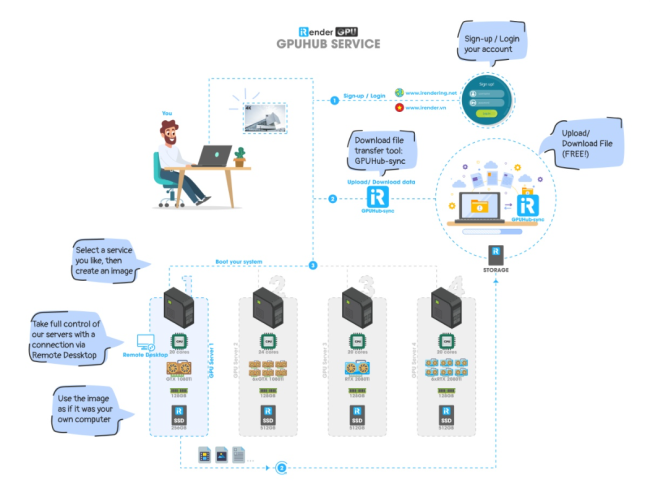
When I work with an IaaS render farm, it feels very similar to working on a powerful remote workstation rather than using a “ready-made” rendering service. With this model, I rent raw computing resources, usually high-end CPU or GPU servers and I’m responsible for almost everything that runs on top of that infrastructure.
What I like about IaaS render farms is the level of control they offer. I can choose the operating system, install my own 3D software, set up specific renderer versions, manage plugins, and fine-tune render settings exactly the way my pipeline requires. This is especially useful when I’m dealing with complex scenes, custom tools, or production workflows that don’t fit into standard presets.
However, that freedom comes with responsibility. Using an IaaS render farm usually means I need solid technical knowledge: handling software installation, licensing, environment setup, and sometimes even troubleshooting system-level issues. It’s not something I’d recommend if I just want to upload a file and hit render as quickly as possible.
I think that IaaS render farms are best suited for experienced artists, technical directors, or studios that need maximum flexibility and already have a well-defined pipeline. If you value control and customization over simplicity, this type of render farm can be a very powerful option for serious 3D modeling and rendering work.
Top IaaS render farm: iRender
Software as a Service (SaaS) render farm
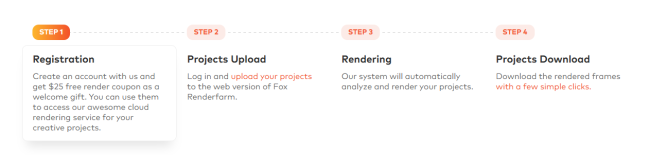
When I use a SaaS render farm, the experience is completely different from working with raw infrastructure. Instead of building or managing a system, I interact with a finished platform that’s already designed for rendering. Everything from the hardware environment to the rendering pipeline is predefined, and my role is simply to prepare the scene correctly and let the service handle the rest.
What stands out to me most about SaaS render farms is how streamlined the workflow becomes. I don’t need to think about operating systems, software installation, or hardware configuration. The platform already knows how to handle common 3D software and renderers, so once my project is uploaded, rendering can start almost immediately. This makes SaaS extremely efficient when I need fast turnaround times or when I’m working on multiple projects at once.
At the same time, I’ve learned that SaaS render farms work best when my 3D modeling and rendering setup follows standard practices. Because the environment is controlled by the provider, I usually have limited access to custom plugins, unusual software versions, or highly specialized scripts. For most simple scenes, this isn’t an issue, but when a project requires a very specific pipeline, SaaS can feel restrictive compared to IaaS.
From my experience, SaaS render farms are ideal when simplicity, speed, and reliability are more important than deep customization. If my goal is to render efficiently without worrying about technical overhead, SaaS is often the most practical choice, especially for freelance work, short deadlines, and well-optimized scenes.
Top SaaS render farm: Fox Renderfarm, RebusFarm, GarageFarm
Summary
| Criteria | IaaS render farm | SaaS render farm |
| Level of control | Full control from OS, software versions, renderers, plugins, and pipeline | Limited – the environment is predefined by the provider |
| Workflow flexibility | Extremely flexible, suitable for custom or complex pipelines | Best for standard, well-optimized workflows |
| Technical knowledge required | High – suitable for experienced artists or technical teams | Low – beginner-friendly |
| Speed of getting started | Slower initial setup, but powerful once configured | Fast – upload and render |
| Best use cases | Complex scenes, custom tools, long animation projects | Freelance work, short deadlines, fast production |
Which is the best for your 3D modeling?
In my opinion, there’s no single best option for everyone. If your 3D modeling workflow requires full control, custom software setups, or complex pipelines, IaaS render farms are the better choice. But when you prioritize speed, simplicity, and fast turnaround, especially for standard scenes, SaaS render farms are usually more practical. In the end, the best render farm is the one that fits how I work, not the most powerful one on paper. And one thing you also need to consider is your money of course.
Final thoughts
Choosing between IaaS and SaaS render farms isn’t about which one is better overall, but which one fits our workflow at the right time. Hope that my experience can help you!
Maybe you need this article: Top 5 Best Render Farms For 2026

COMMENTS